Customized Electric Vehicle Charger Enterprise
Home

Fast charging technology

Fast charging technology

  • Is the Global EV Charging Infrastructure Entering an Acceleration Phase?
    Is the Global EV Charging Infrastructure Entering an Acceleration Phase?
    Oct 17, 2025
    As electric vehicles (EVs) continue to surge worldwide, the global charging infrastructure is clearly entering an accelerated phase of development. Recent reports show that the number of public charging points has grown by more than 45% year-on-year — one of the fastest expansions in clean mobility history. This momentum reflects not only the rise of EV adoption but also the urgent need for smarter, faster, and more reliable charging networks. 🌍 Why Is This Acceleration Happening? Several factors are driving this global growth: ⭐️Government incentives and policies in key regions such as Europe, China, and North America are supporting large-scale charger deployment. ⭐️Private investment is increasing as energy and tech companies recognize the long-term potential of EV charging. ⭐️Consumers’ trust in EVs continues to strengthen with improved battery range and lower ownership costs. Together, these trends are turning EV charging from a niche service into a critical part of the global energy ecosystem. ⚙️ What Challenges Still Exist? While expansion is rapid, challenges remain. In many regions, charging accessibility and grid capacity are not yet balanced with growing demand. Compatibility between different systems and charging standards also poses barriers to seamless EV travel. Building a network that is fast, accessible, and intelligent is now the next frontier. 🔋 How FES Power Is Powering the Transition At FES Power, we are helping shape the next phase of global charging infrastructure with our smart and high-efficiency EV chargers. Our solutions feature: ⭐️Fast-charging capability for both commercial and public applications ⭐️Dynamic load balancing and OCPP protocol for intelligent management ⭐️Integration with renewable energy systems to enhance sustainability Whether for urban areas, highways, or fleet operations, FES Power’s chargers deliver reliable, scalable, and eco-friendly performance that meets the pace of global EV growth. 🌱 Looking Ahead The world’s shift toward a zero-emission future depends on how fast charging infrastructure can evolve. As more nations commit to electrification, partnerships between innovators, policymakers, and energy providers will determine the speed of this transformation. At FES Power, we are ready to drive that change — faster, smarter, and greener. 👉 Visit us at www.fescharging.com  to learn more about our solutions.
    Read More
  • The Future of EV Charging: Smarter, Greener, More Connected
    The Future of EV Charging: Smarter, Greener, More Connected
    Nov 07, 2025
    🚘As electrification accelerates, the EV charging industry is undergoing a profound transformation. In the past, the race was all about speed — who could charge faster. But today, the conversation has evolved. The future isn’t just about faster charging — it’s about intelligence, flexibility, sustainability, and connectivity. At FES Power, we are driving this evolution forward. From our high-performance DC fast chargers to our Meta Series mobile charging systems and V2H/V2G bidirectional chargers, we’re redefining what “charging” can mean — not just for vehicles, but for the entire energy ecosystem. 💡 Because to us, the true future of charging isn’t just power — it’s connection.    ⚙️ Is “Faster Charging” Enough for the Future? Ultra-fast charging has become the industry benchmark — 600kW power, 800V platforms, and advanced liquid-cooled cables are now shaping the next generation of chargers.  ⏩But here’s a question worth asking: Once “fast” becomes standard, what comes next? We believe the answer lies in making charging smarter — where the charger adapts, communicates, and learns to optimize every connection. 🤖 Can a Charger “Think”? Yes — and it already is. 🔍 Smart charging technology is transforming how energy is distributed and managed: ⚙️Dynamic power allocation  🛰️Cloud monitoring & data-driven insights  🧠Predictive maintenance and AI-based diagnostics  Within the FES Power ecosystem, intelligent control systems enable load balancing across multiple chargers, optimizing performance and minimizing power waste. When a charger can think, energy becomes truly intelligent. 🌿 How Can Charging Be Greener? 🌱EVs are only as clean as the energy that powers them.  ☀️🔋That’s why FES Power is advancing integrated solar + storage + DC charging solutions, creating self-sustaining systems that utilize renewable energy wherever possible.  In the cities and industrial parks of tomorrow, sunlight, storage, and smart charging will form a continuous, circular energy loop. Sustainability is no longer just an idea — it’s becoming a real, deployable solution. 🚗 Do We Still Need Fixed Charging Stations? Maybe not everywhere. 💡 As mobility diversifies, flexibility becomes essential. ⚡Our Meta & Meta+ Mobile Charging Vehicles deliver energy wherever it’s needed — ports, mining sites, events, or emergency zones. 🚙 With these mobile systems, charging is no longer tied to a single location — it moves with you. The future of charging is not fixed, but free. 🔄 Can Chargers, Cars, and the Grid “Talk” to Each Other? Absolutely. 🔌 Through V2X (Vehicle-to-Everything) technology, EVs are evolving into mobile power sources: 🏠V2H: Vehicles powering homes during outages  ⚡V2G: Vehicles returning power to the grid to balance demand  FES Power’s bidirectional chargers make this energy dialogue possible. When energy flows both ways, the grid becomes more stable, and users become active participants in the energy ecosystem. 🌐 Conclusion: The Future of Charging Is a Multi-Dimensional Revolution The next era of EV charging isn’t just about “speed”. ⚡ It’s about being smarter, greener, more flexible, and more connected. 🌍FES Power is creating the link between today’s innovation and tomorrow’s energy freedom. 💡🛜https://www.fescharging.com/  
    Read More
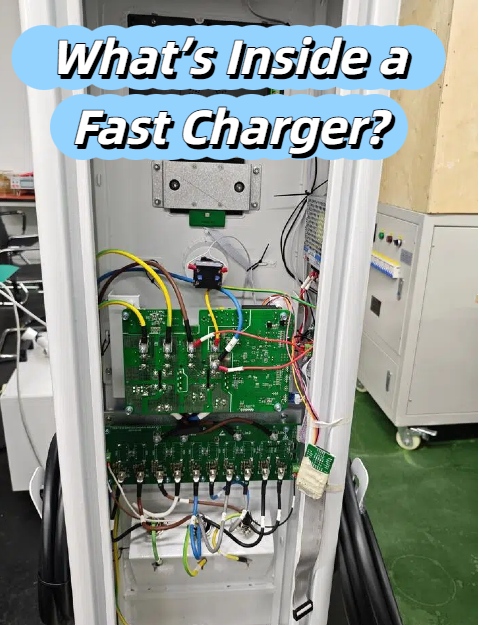
  • What’s Inside a DC Charger?
    What’s Inside a DC Charger?
    Nov 17, 2025
    As EV adoption accelerates worldwide, charging stations have quietly become the backbone of clean transportation. Yet while drivers see only a sleek cabinet and a simple plug-and-charge interface, few truly understand what happens behind that metal enclosure. Today, let’s take a clear, science-based look at the internal structure of a DC fast charger—and use FES Power’s D30 series as a real-world example. 🔌 What Makes Up the Power Input System? Every charger starts with electricity from the grid. For DC fast chargers, this requires a stable AC input system that manages: 🛡️Three-phase AC supply 🛡️Voltage range (typically 380–415V) 🛡️Frequency and power factor 🛡️Maximum input current 🛡️Grid protection and filtering For the D30, the AC input includes: ⭐️3-phase, 5-wire system (L1, L2, L3, N, PE) ⭐️Input voltage: 380–415Vac ⭐️Power factor: ≥0.98 ⭐️Max input current: 220A (120 kW) / 300A (160 kW) This ensures stable operation even under fluctuating grid conditions. ⚙️ How Does the Power Module Convert AC to DC? At the heart of every DC charger lies the power module—the unit responsible for converting AC into the direct current EV batteries require. The FES Power D30 adopts a modular architecture, allowing flexible configuration: 📁30 kW modules 📁40 kW modules Combined output: 120 kW or 160 kW Modular design provides major advantages: 💡Easy maintenance 💡Quick replacement during failure 💡Scalable power output 💡Fewer single-point failures It’s the “engine” of the charger. 🧠 How Does the Control System Coordinate Everything? A modern DC charger is a smart device. Its control system handles: 💫Communication with the vehicle 💫Power delivery strategies 💫Real-time monitoring 💫User authentication 💫Safety protection 💫Cloud connectivity & remote updates The D30 control system supports: ☑️ISO 15118 (incl. Plug & Charge) ☑️7-inch touchscreen UI ☑️OCPP 1.6J / 2.0.1 ☑️Ethernet, Wi-Fi & 4G This makes the charger fully cloud-manageable and operator-friendly. 🔋 What Does the Output Section Include? This is the part the user actually touches—plug, cable, and interface. D30 Output Specs: ⭐️CCS2 connector ⭐️4-meter cable ⭐️Output voltage: 200–1000V ⭐️Max current: 250A Wide voltage compatibility ensures support for modern high-voltage EV platforms—now and in the future. 🏗️ How Do the Structure & Cooling Systems Ensure Reliability? Outdoor DC chargers must operate in rain, dust, heat, frost, or high humidity. This requires a robust mechanical design. D30 Structural Features: 🛡️Integrated structural design for easier installation 🛡️IP54 ingress protection 🛡️IK10 vandal-resistance (except display area) 🛡️Forced-air cooling 🛡️Operating range: -20°C to 50°C These ensure long-term durability even in challenging environments. ⚡ How Does a DC Charger Actually Work Internally? Here’s a simplified workflow anyone can understand: 🔷EV plugs in → handshake begins 🔷Battery data exchanged → charging strategy generated 🔷Power modules convert AC → DC 🔷DC output delivered to battery 🔷System monitors temperature, voltage & current 🔷Charging completes → power disconnects safely The D30 includes multiple safety protections: OVP, UVP, OCP, OTP, SPD, RCD, IMD, and more. Safety is embedded into every charging step. 🚗 What Defines a Great DC Fast Charger? A high-quality charger should include: 👍Modular power architecture 👍High efficiency (>96%) 👍ISO 15118 smart communication 👍Advanced connectivity (OCPP, Wi-Fi, 4G) 👍Wide output voltage & high current 👍Strong physical protection 👍User-friendly interface The FES Power D30 (120kW / 160kW) embodies all these structural strengths, making it ideal for: ⭐️Public charging stations ⭐️Commercial parking lots ⭐️Fleet depots ⭐️Urban fast-charging hubs 👉 Learn more about FES Power’s charging solutions: 🌐 https://www.fescharging.com/
    Read More
  • Is Ultra-Fast Charging the Turning Point for EV Adoption in 2026?
    Is Ultra-Fast Charging the Turning Point for EV Adoption in 2026?
    Jan 05, 2026
    The electric vehicle (EV) industry is reaching a decisive moment in 2026. Global EV sales surpassed 20 million units in 2025, accounting for more than 25% of global new car sales 📈. Yet one question continues to dominate industry discussions: 👉 Is charging infrastructure finally ready to support mass EV adoption? With the rapid rise of ultra-fast charging (UFC) technology, the answer may now be yes. By significantly reducing charging time and improving user convenience, ultra-fast charging is reshaping how consumers, fleets, and operators perceive EVs. 🌍 Global EV Charging Infrastructure: Growth With Gaps The global charging network continues to expand rapidly: 🌐 1.3 million+ public charging points were added globally in 2024 📊 This represents a 30% year-on-year increase ⚡ Ultra-fast chargers (≥150 kW) grew by 50%+, but still account for only ~10% of public fast chargers This imbalance highlights a critical reality: quantity alone is not enough. The future of EV adoption depends on power level, efficiency, and scalability. Meanwhile, the global EV fast-charging market is projected to reach USD 33 billion by 2033, driven primarily by demand for high-power DC charging solutions 💼📈. ⚡ Why Ultra-Fast Charging Changes Everything Charging speed is no longer a “nice-to-have”—it is a deciding factor for EV buyers.   📌 Key data insights show: Ultra-fast charging usage grew nearly 40%  YoY Lower-power DC chargers are seeing declining utilization Advanced ultra-fast stations can add 300 km of range in ~5 minutes ⏱️ This brings EV charging closer than ever to the ICE refueling experience ⛽➡️🔌. From a consumer psychology standpoint 🧠, ultra-fast charging significantly reduces: ⚠️ Range anxiety ⏳ Charging time frustration 🛣️ Long-distance travel hesitation Result: higher confidence, faster adoption, and better user satisfaction ✅. 🚧 Challenges Ahead — and Why Power Matters Despite progress, challenges remain: Some regions saw charger deployment slowdowns (e.g., UK public installations dropped in 2025)              📉 The EV-to-charger ratio is expected to worsen, rising from 7.5 EVs per charger (2025) to 14+ by 2040 🔌 Grid capacity constraints demand smarter, more efficient charging solutions This underscores a clear conclusion: The next phase of infrastructure growth must be faster, smarter, and more powerful. 🔋 Introducing FES Power Ultra-Fast Charging Solutions (480–920 kW) At FES Power, we believe ultra-fast charging is not just innovation—it is infrastructure readiness for the next decade ⚙️. Our 480–920 kW ultra-fast DC charging systems are designed to meet both today’s high-power needs and tomorrow’s EV architectures. ⭐ Key Advantages ⚡ 480–920 kW High-Power Output Supports 800 V+ EV platforms and future high-voltage vehicles ❄️ Advanced Liquid-Cooling Technology Enables sustained high-power delivery with thermal stability 🧩 Modular & Scalable Architecture Ideal for highway hubs, fleet depots, and large-scale charging parks 🔌 Multi-Vehicle & Multi-Protocol Support Designed for flexible, future-ready deployments 🌱 Smart Energy & Grid Integration Optional energy storage and intelligent power management reduce grid stress 💼 Value for Operators and Drivers Ultra-fast charging delivers tangible benefits across the ecosystem: 1️⃣ Shorter Dwell Time 80% SOC achieved in minutes, not hours ⏱️ 2️⃣ Higher Station Throughput More vehicles served per day = higher ROI 📊 3️⃣ Future-Proof Investment Ready for next-generation EV platforms 🚀 4️⃣ Sustainable Infrastructure Optimized energy use and renewable integration 🌍♻️ 🔮 Conclusion: Ultra-Fast Charging Is the Inflection Point Ultra-fast charging is no longer experimental—it is becoming the new standard. 📈 The data is clear ⚡ The technology is ready 🚗 The market is demanding it As EV adoption accelerates in 2026 and beyond, high-power charging infrastructure will define success. At FES Power, our 480–920 kW ultra-fast charging solutions are built to power this transition—supporting operators, cities, and businesses in delivering a faster, smarter, and more reliable EV charging future.
    Read More
  • How Fast Is “Fast Charging”, Really?
    How Fast Is “Fast Charging”, Really?
    Jan 12, 2026
    Fast charging has become one of the most frequently used — and most misunderstood — terms in the EV industry. But how fast is “fast,” really? Is 50 kW still considered fast charging today? And does higher power always mean better performance? Let’s break it down with real data, real-world use cases, and practical insights. 🔍What Does “Fast Charging” Actually Mean?  In technical terms, fast charging usually refers to DC (direct current) charging, where power is delivered directly to the vehicle’s battery, bypassing the onboard charger. ✨AC charging: typically 7–22 kW ✨DC fast charging: starts around 50 kW ✨Ultra-fast charging: commonly 150 kW and above However, calling something “fast” without context can be misleading. A charger’s speed must always be evaluated against battery size, vehicle acceptance rate, and charging curve behavior, not just the kW number. ⏱️How Long Does Fast Charging Take in Real Numbers?  Let’s look at a typical example using a 70 kWh EV battery, charging from 20% to 80% (the most common fast-charging window): ✨50 kW DC charger: ~45–60 minutes ✨150 kW DC charger: ~20–30 minutes ✨250 kW DC charger: ~15–20 minutes On paper, higher power dramatically reduces charging time. In reality, the actual speed depends on whether the vehicle can sustain high power throughout the session — something many EVs cannot.  🔋Why Don’t EVs Charge at Maximum Power All the Time? EV batteries follow a charging curve, not a straight line. ✨Peak power is usually reached between 20%–40% SOC ✨Power gradually tapers down after 60% SOC ✨Above 80%, charging slows significantly to protect battery health This means a 250 kW charger does not deliver 250 kW for the entire session. The benefit of high-power charging lies in shortening the high-demand window, especially during peak operating hours. 🚀When Does Ultra-Fast Charging Truly Make Sense?  Ultra-fast charging (300 kW–960 kW systems) is not designed for every scenario. It delivers the most value in environments where time equals revenue: 💫Highway service areas 💫Public fast-charging hubs 💫Logistics and fleet depots 💫Bus and heavy-duty vehicle operations In these scenarios, throughput matters more than individual session efficiency. Reducing charging time by even 10 minutes can significantly increase daily station utilization. ⚙️Is More Power Always Better for Charging Stations?  Not necessarily. Installing higher power without a flexible architecture often leads to: Underutilized capacity Higher grid connection costs Inefficient energy allocation during off-peak hours This is why modern charging infrastructure is shifting toward centralized, modular power systems with dynamic power distribution, rather than fixed-power standalone chargers. 🔌📊How Can Charging Power Be Used More Efficiently?  Advanced DC charging systems now rely on: Wide voltage output ranges (e.g. 150–1000V) Dynamic power allocation across multiple connectors Scalable power modules For example, FES Power’s high-power DC charging solutions are designed to adapt power output in real time, allowing: Multiple vehicles to charge simultaneously Power to be distributed based on actual demand Future expansion without replacing the entire system This approach ensures that “fast charging” remains fast — even during peak usage. 🌍What Does “Fast Charging” Mean for the Future?  As EV adoption accelerates, the industry is moving beyond single-vehicle speed toward system-level efficiency: Faster turnover, not just faster sessions Smarter power management, not just higher kW Infrastructure designed for scalability, not short-term demand In this context, fast charging is no longer defined by a single number, but by how intelligently power is delivered. ✅So, How Fast Is “Fast Charging”, Really?  Fast charging is not just about reaching the highest kW rating. It is about: Delivering the right power at the right time Matching charger capability with vehicle behavior Designing systems that maximize uptime and utilization When these elements come together, fast charging becomes not just fast — but truly effective.
    Read More

leave a message

leave a message
If you are interested in our products and want to know more details,please leave a message here,we will reply you as soon as we can.
submit
Contact Us: bella@fespower.cn

home

products

WhatsApp

Contact Us