Customized Electric Vehicle Charger Enterprise
Home

Smart EV charging solutions

Smart EV charging solutions

  • What’s Inside a DC Charger?
    What’s Inside a DC Charger?
    Nov 17, 2025
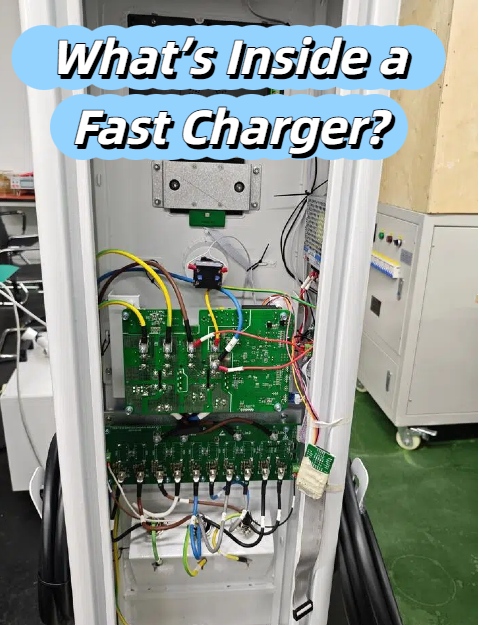
    As EV adoption accelerates worldwide, charging stations have quietly become the backbone of clean transportation. Yet while drivers see only a sleek cabinet and a simple plug-and-charge interface, few truly understand what happens behind that metal enclosure. Today, let’s take a clear, science-based look at the internal structure of a DC fast charger—and use FES Power’s D30 series as a real-world example. 🔌 What Makes Up the Power Input System? Every charger starts with electricity from the grid. For DC fast chargers, this requires a stable AC input system that manages: 🛡️Three-phase AC supply 🛡️Voltage range (typically 380–415V) 🛡️Frequency and power factor 🛡️Maximum input current 🛡️Grid protection and filtering For the D30, the AC input includes: ⭐️3-phase, 5-wire system (L1, L2, L3, N, PE) ⭐️Input voltage: 380–415Vac ⭐️Power factor: ≥0.98 ⭐️Max input current: 220A (120 kW) / 300A (160 kW) This ensures stable operation even under fluctuating grid conditions. ⚙️ How Does the Power Module Convert AC to DC? At the heart of every DC charger lies the power module—the unit responsible for converting AC into the direct current EV batteries require. The FES Power D30 adopts a modular architecture, allowing flexible configuration: 📁30 kW modules 📁40 kW modules Combined output: 120 kW or 160 kW Modular design provides major advantages: 💡Easy maintenance 💡Quick replacement during failure 💡Scalable power output 💡Fewer single-point failures It’s the “engine” of the charger. 🧠 How Does the Control System Coordinate Everything? A modern DC charger is a smart device. Its control system handles: 💫Communication with the vehicle 💫Power delivery strategies 💫Real-time monitoring 💫User authentication 💫Safety protection 💫Cloud connectivity & remote updates The D30 control system supports: ☑️ISO 15118 (incl. Plug & Charge) ☑️7-inch touchscreen UI ☑️OCPP 1.6J / 2.0.1 ☑️Ethernet, Wi-Fi & 4G This makes the charger fully cloud-manageable and operator-friendly. 🔋 What Does the Output Section Include? This is the part the user actually touches—plug, cable, and interface. D30 Output Specs: ⭐️CCS2 connector ⭐️4-meter cable ⭐️Output voltage: 200–1000V ⭐️Max current: 250A Wide voltage compatibility ensures support for modern high-voltage EV platforms—now and in the future. 🏗️ How Do the Structure & Cooling Systems Ensure Reliability? Outdoor DC chargers must operate in rain, dust, heat, frost, or high humidity. This requires a robust mechanical design. D30 Structural Features: 🛡️Integrated structural design for easier installation 🛡️IP54 ingress protection 🛡️IK10 vandal-resistance (except display area) 🛡️Forced-air cooling 🛡️Operating range: -20°C to 50°C These ensure long-term durability even in challenging environments. ⚡ How Does a DC Charger Actually Work Internally? Here’s a simplified workflow anyone can understand: 🔷EV plugs in → handshake begins 🔷Battery data exchanged → charging strategy generated 🔷Power modules convert AC → DC 🔷DC output delivered to battery 🔷System monitors temperature, voltage & current 🔷Charging completes → power disconnects safely The D30 includes multiple safety protections: OVP, UVP, OCP, OTP, SPD, RCD, IMD, and more. Safety is embedded into every charging step. 🚗 What Defines a Great DC Fast Charger? A high-quality charger should include: 👍Modular power architecture 👍High efficiency (>96%) 👍ISO 15118 smart communication 👍Advanced connectivity (OCPP, Wi-Fi, 4G) 👍Wide output voltage & high current 👍Strong physical protection 👍User-friendly interface The FES Power D30 (120kW / 160kW) embodies all these structural strengths, making it ideal for: ⭐️Public charging stations ⭐️Commercial parking lots ⭐️Fleet depots ⭐️Urban fast-charging hubs 👉 Learn more about FES Power’s charging solutions: 🌐 https://www.fescharging.com/
    Read More
  • Why the World Is Racing to Build Ultra-Fast EV Charging Networks in 2025
    Why the World Is Racing to Build Ultra-Fast EV Charging Networks in 2025
    Nov 24, 2025
    The global EV market is entering a high-speed growth phase. In 2025 alone, worldwide EV sales are projected to exceed 20 million units, up from 14 million in 2023. This rapid adoption is driving governments and companies to accelerate fast-charging deployment. China currently leads the world with 18.64 million charging points, including 4.53 million public chargers, while the U.S. and Europe are expanding 150–350 kW chargers at record speed. The common ambition is clear: reduce charging waiting time and support mass electrification. 🔌How Are Major Countries Upgrading Their Fast-Charging Networks? 🚀 China recently announced a 2025–2027 national action plan to double its public charging capacity, aiming for 28 million charging facilities and over 300 GW of public charging load by 2027. In the U.S., companies like ChargePoint are rolling out fast chargers designed for 10-minute charging sessions, while Hyundai is pushing for 400 kW+ ultra-fast charging, targeting near “fuel-station speed.” Europe is also investing heavily in highway fast-charging corridors to meet its Fit-for-55 climate mandate. Together, these initiatives reveal a global race to build dense, high-power networks. ⏱️Why Is High-Power Charging Becoming Non-Negotiable? ⚡ Consumers expect EVs to charge as fast as they refuel. Today’s standard EV charging still requires 30–40 minutes at a 100–150 kW charger, but new systems aim to reduce this to 5–10 minutes. To enable these speeds, stations must support higher power, better cooling, and upgraded distribution systems. Studies show that regions with reliable fast charging see 30% higher EV adoption rates, proving that charging convenience directly shapes market growth. 📡What Role Does Smart Charging and Software Intelligence Play? 🤖 Charging infrastructure is no longer just hardware—it’s a cloud-connected ecosystem. Platforms now offer real-time charger availability, dynamic load balancing, and predictive energy management. Google Maps’ new charger-availability forecasting feature is a major milestone, helping reduce user wait times and optimizing station traffic flow. These intelligent systems help operators avoid peak load stress while improving overall user experience. ⚡How Do Emerging Technologies Like Wireless Charging and V2G Accelerate Progress? 🔄 Wireless charging pilots in the U.S. and Europe aim to power vehicles while parked or even in motion, while China is rapidly scaling V2G (Vehicle-to-Grid) deployment, targeting 5,000+ bidirectional stations by 2027. V2G allows EVs to export power back to the grid—creating virtual power plants and supporting grid stability. These technologies represent the next wave of EV-energy integration, enabling smarter, more flexible energy ecosystems. 🌐How Does FES Power Contribute to the Global Fast-Charging Revolution? 🔋 At FES Power, we are committed to empowering the next generation of high-performance charging. Our flagship solutions include: ⚡ FES DC Fast-Charging Series (30–240 kW) 🔷Optimized for highway and commercial applications 🔷Supports ultra-fast charging requirements and scalable power modules 🔷Built with high-efficiency SiC power components 🔷Ideal for fleet charging, public stations, and industrial deployment ⚡ FES Wallbox Series (7–22 kW) 🔷Smart home charging with app monitoring 🔷RFID, Bluetooth, and OCPP communication 🔷Compact, durable, and easy to install ⚡ FES Mobile Charging Vehicle 🔷Emergency rapid charging for stranded EVs 🔷Ideal for remote areas, logistics fleets, and roadside assistance With global charging demand projected to triple by 2030, FES Power is actively supporting operators, governments, and partners in building reliable, high-speed and intelligent charging ecosystems. 🔮What Does the Future of Fast-Charging Look Like? 🚗⚡ By 2030, experts predict more than 50% of public chargers will be high-power systems above 150 kW, while ultra-fast 350–500 kW stations become common along highways. Integrated energy storage, AI-powered management, wireless charging lanes, and bidirectional energy trading will redefine how vehicles interact with energy networks. The nations that build fast, dense, and intelligent charging ecosystems will lead the next decade of global electrification.
    Read More

leave a message

leave a message
If you are interested in our products and want to know more details,please leave a message here,we will reply you as soon as we can.
submit
Contact Us: bella@fespower.cn

home

products

WhatsApp

Contact Us