Customized Electric Vehicle Charger Enterprise
Home

Solar Storage EV Charging

Solar Storage EV Charging

  • What Feels Different When Charging with Solar + Storage Integrated Systems?
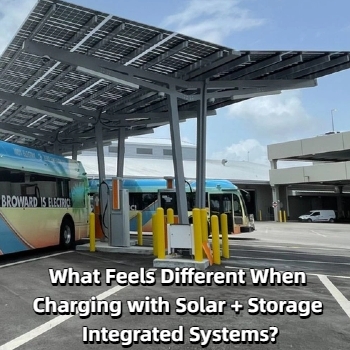
    What Feels Different When Charging with Solar + Storage Integrated Systems?
    Apr 08, 2026
    As EV adoption accelerates, drivers are starting to notice something unexpected:👉 Not all charging experiences feel the same — even when the charger rating looks identical.So what’s really behind this difference?The answer often lies beyond the charger itself. It’s about how energy is managed. Why Do Some Charging Stations Feel Smooth — While Others Don’t?You might have experienced this:⚡ A charger starts fast… then suddenly slows down 📉 Charging speed fluctuates unpredictably ⏳ Peak hours mean long waits or limited availabilityOn paper, these stations may offer similar power ratings — 120kW, 250kW, even higher.But in reality, the experience feels completely different.👉 The reason is simple: Traditional charging stations rely entirely on the grid.And the grid has limits. What Changes with Solar + Storage Integration?Now imagine a different scenario.You arrive at a charging station, plug in, and:⚡ The charging speed remains stable from start to finish 🔄 No sudden power drops 🕒 Even during peak hours, performance stays consistentThis is what a solar + energy storage + charging integrated system delivers.Instead of depending solely on grid supply, the system intelligently coordinates:☀️ Solar energy generation 🔋 Battery energy storage ⚡ High-power charging output👉 The result is not just “fast charging” — but predictable and consistent charging. Charging Experience: The Real DifferenceLet’s break it down from a user perspective:1. Stability Over Peak PowerTraditional stations may advertise high peak power, but often cannot sustain it.Integrated systems buffer energy through storage, ensuring:🔋 Continuous high output 📊 Minimal fluctuation👉 Charging feels faster because it stays fast. 2. No More “Slowdown Anxiety”One of the biggest frustrations is unexpected speed drops.With energy storage acting as a buffer:⚖️ Peak demand is absorbed 🔌 Grid limitations are bypassed👉 The experience becomes smooth and reliable. 3. Better Availability, Less WaitingIn grid-constrained environments, stations often limit output or connections.But integrated systems can:🔄 Distribute power dynamically 🚗 Support more simultaneous charging sessions👉 This leads to higher throughput and shorter queues. 4. Consistency Across TimeMorning, noon, or night — traditional stations behave differently depending on grid load.With solar + storage:🌞 Daytime: solar supports charging ⚡ Peak hours: storage stabilizes output 🌙 Night: stored energy ensures continuity👉 The experience becomes time-independent. Behind the Experience: Intelligent Energy ManagementThe real shift is not hardware — it’s energy orchestration.Modern integrated systems use smart EMS (Energy Management Systems) to:🧠 Balance grid and battery usage 📉 Perform peak shaving ⚡ Optimize charging output dynamically This is why:👉 Charging speed is not defined by peak power — but by sustained power.Introducing C300: A New Standard for Integrated Charging ExperienceTo deliver this next-level experience, solutions like the C300 Solar + Storage Integrated EV Charger are redefining how charging infrastructure is built. Based on your provided specs, here’s what makes it stand out:⚡ High-Power, Yet Stable Output⚡ Up to 480kW system output ❄️ Supports 600A liquid-cooled ultra-fast charging 👉 Not just powerful — but designed to maintain output under real-world conditions🔋 Built-in Energy Storage Buffer🔋 Integrated 261.25 kWh LiFePO4 battery system 🔄 Long lifecycle: 6000+ cycles 👉 Ensures: ⚡ Stable charging performance 🔌 Reduced reliance on grid fluctuations ⚙️ Dynamic Power Sharing🔄 Intelligent dynamic power distribution across charging outputs 👉 Meaning: 🚗 Multiple vehicles can charge efficiently 📈 No wasted capacity ⚡ Higher stat🔌 Supports on-grid & off-grid operation 🏗️ No need for costly grid upgrades👉 Key advantage: 📍 Deploy in grid-limited areas ⏱️ Avoid years of infrastructure delays☀️ Solar Integration Ready☀️ MPPT-enabled photovoltaic input 👉 Enables: 💰 Renewable energy utilization 📉 Lower operating costs (up to 30–50%) 🚀 Built for Real-World Scalability🧩 Modular expansion for both power and storage 👉 Future-proof design: 📈 Scale with demand 🔧 No major redesign needed From Equipment to ExperienceThe evolution of EV charging is no longer just about higher kW numbers.It’s about:⚡Stability 📊 Consistency 🚗 Availability 🌱 Energy independence👉 In short: better user experience Final ThoughtAs EV infrastructure continues to scale, the gap between traditional charging and integrated systems will only widen.Because in the end:👉 Users don’t remember the power rating 👉 They remember how the charging felt And that’s exactly where solar + storage integrated systems make the difference.
    Read More
  • What Is The Best EV Charger Solutions For Commercial Charging Stations
    What Is The Best EV Charger Solutions For Commercial Charging Stations
    Apr 15, 2026
    As electric vehicles continue to scale globally, commercial charging stations are rapidly becoming a critical infrastructure investment. For businesses such as shopping malls, highways, office parks, and fleet depots, choosing the right EV charger solution is not just about hardware—it’s about efficiency, scalability, and long-term ROI. ⚡ What Makes A Good Commercial EV Charger Solution?A successful commercial EV charging station requires more than just installing chargers. It involves a complete ecosystem thatcombines hardware, software, and energy management.First, high reliability and uptime are essential. Commercial chargers must operate continuously under high utilization, minimizing downtime and maintenance costs. Robust and weatherproof designs (e.g., IP-rated systems) ensure long-term performance in demanding environments. Second, scalability is critical. Businesses often start with a few chargers but need to expand as EV adoption grows. Scalable systems allow operators to increase capacity without redesigning infrastructure. Third, smart management systems play a key role. Cloud-based platforms enable remote monitoring, payment integration, load balancing, and diagnostics—helping operators maximize efficiency and revenue. Finally, power flexibility is essential. Commercial scenarios require a mix of AC and DC chargers, typically ranging from 22kW AC to 480kW+ DC fast charging to meet different user needs. 🚗 Key Types Of Commercial EV Charger SolutionsDifferent commercial scenarios require different charger configurations:1️⃣ Destination Charging (AC Chargers)Ideal for offices, hotels, and malls where vehicles stay longer. Lower power (7kW–22kW) but cost-effective.2️⃣ Fast Charging (DC Chargers)Suitable for highways and urban hubs, offering 60kW–480kW for quick turnaround and high traffic flow.3️⃣ Ultra-Fast & Split-Type SystemsDesigned for large-scale stations and fleets, enabling flexible power distribution across multiple charging guns.4️⃣ Solar + Storage + Charging IntegrationCombining EV chargers with energy storage reduces grid dependency and optimizes energy costs, especially in high-demand scenarios.💼 How EV Charging Stations Generate Business Value Installing EV chargers is no longer just a sustainability move—it’s a revenue strategy.Commercial charging stations can:1️⃣ Increase customer dwell time and spending2️⃣ Attract high-value EV drivers3️⃣ Generate direct charging revenue4️⃣ Enhance brand image and visibility on charging mapsIn fact, many businesses are now treating EV charging as a new profit center, similar to traditional fuel stations. 🔋 FES Power Commercial EV Charger Solutions As a professional EV charging solution provider, FES Power delivers a full portfolio tailored for commercial applications: 1️⃣ ⚡ High-Power DC Fast Chargers (60kW–240kW) Ideal for urban charging stations and commercial parking Dual-gun design for higher utilization Supports global standards (CCS, CHAdeMO, GB/T)2️⃣ 🚀 Split-Type Ultra-Fast Charging Systems (Up To 960kW+)Centralized power cabinet + distributed charging terminalsDynamic power allocation improves efficiencyPerfect for highways, fleets, and high-traffic hubs3️⃣ 🌞 Solar + Storage Integrated Charging SolutionsCombine EV charging with battery storage systemsReduce peak demand costsEnable off-grid or weak-grid deployment4️⃣ 📊 Smart Charging Management PlatformRemote monitoring and diagnosticsFlexible pricing and payment integrationOCPP-compatible for network expansion These solutions are designed to help operators maximize ROI, improve station utilization, and future-proof their infrastructure. 🔧 Conclusion: Choosing The Right SolutionSelecting the best EV charger solution for commercial charging stations depends on your business model, location, and expected traffic. A successful deployment should balance:1️⃣ Power capacity vs. demand2️⃣ Initial investment vs. long-term ROI3️⃣ Scalability and future expansion4️⃣ Smart energy and operational management With the right strategy and technology partner like FES Power, commercial EV charging stations can evolve from a cost center into a high-growth, revenue-generating asset in the new energy ecosystem.  
    Read More
  • Why Battery Storage Is Essential For Fast EV Charging
    Why Battery Storage Is Essential For Fast EV Charging
    May 13, 2026
    ⚡ Why Is Fast EV Charging Creating Pressure On The Power Grid? As EV adoption accelerates worldwide, ultra-fast charging stations are expanding rapidly across highways, cities, logistics hubs, and commercial fleets. But behind this growth, one major challenge is becoming impossible to ignore: Power grid capacity. According to the International Energy Agency (IEA), global public charging infrastructure must grow nearly 9 times by 2035 to support rising EV demand. At the same time, charging power is also increasing dramatically — from 60kW and 120kW systems to today’s 480kW, 600kW, and even megawatt-level charging solutions. 🔋 Why Can’t Traditional Grids Handle Ultra-Fast Charging Alone? A single 600kW fast charger can consume as much electricity as dozens of homes simultaneously. For fleet depots or charging hubs with multiple chargers operating together, peak demand can quickly exceed local grid capacity. Research from McKinsey & Company  estimates that grid connection upgrades can account for up to 30%-40% of total charging station deployment costs in high-power charging projects. This is exactly why battery energy storage systems (BESS) are becoming essential. ⚙️ How Does Battery Storage Actually Improve EV Charging? Battery storage acts as an intelligent energy buffer between the grid and charging equipment. Instead of drawing massive power spikes directly from the grid, the system can: 🔋 Store electricity during off-peak hours ⚡ Release energy during high charging demand 📉 Reduce peak grid pressure 💰 Lower electricity costs through peak shaving ☀️ Integrate with solar energy systems 🔄 Improve charging stability and uptime This architecture is rapidly becoming the preferred model for modern charging infrastructure. 📊 What Do Industry Data And Market Trends Show? According to BloombergNEF, global battery energy storage deployment is expected to grow more than 20-fold by 2030. Meanwhile, many charging operators are shifting their focus from simply installing chargers to optimizing energy management. Recent surveys across Europe and Asia indicate that charging station operators are increasingly prioritizing: ✅ Grid stability ✅ Energy efficiency ✅ Peak demand reduction ✅ Renewable energy integration ✅ Long-term operating costs This signals a major industry transformation: EV charging is evolving from simple power delivery into intelligent energy management. 🚀 Why Is Integrated Energy Storage Becoming The Future? In regions such as Europe, the Middle East, Southeast Asia, and remote industrial zones, grid limitations are often one of the biggest barriers to deploying high-power chargers. By combining: ☀️ Solar energy 🔋 Battery storage ⚡ DC fast charging Operators can build more flexible, scalable, and energy-efficient charging ecosystems. This is especially important for: 🚚 Commercial fleet charging 🏭 Industrial parks 🛣️ Highway charging corridors ⛽ Remote charging locations ⚓ Ports and logistics hubs 🔥 How Is FES Power Responding To This Industry Shift? As the EV charging industry evolves toward higher power and smarter energy management, FES Power is actively developing integrated charging and storage solutions designed for next-generation infrastructure. One of the company’s flagship solutions is the Cannon300 integrated charging system. ⚡ Cannon300 Key Advantages 🔋 Integrated energy storage + DC fast charging ⚡ High-power charging capability 🌡️ Advanced thermal management design ☀️ Ready for solar integration 📈 Intelligent energy optimization 🚛 Flexible deployment for commercial applications By integrating energy storage directly into charging infrastructure, Cannon300 helps operators reduce grid dependency, improve charging reliability, and optimize operational efficiency. 🌍 What Will The Next Generation Of Charging Stations Look Like? The future charging station will no longer function as just a charger. Instead, it will become: ⚡ An energy management center 🔋 A distributed storage node ☀️ A renewable energy integration platform 🤖 An AI-driven smart infrastructure system As charging demand continues to rise, battery storage will no longer be optional. It will become one of the core foundations of fast EV charging infrastructure. 🚀 Final Thoughts The EV charging industry is entering a new era. The competition is no longer only about charging speed. Instead, the real focus is shifting toward: 🔋 Energy efficiency ⚡ Grid flexibility 🌍 Sustainable infrastructure 🤖 Intelligent energy management And battery storage is becoming the key technology enabling this transformation.
    Read More

leave a message

leave a message
If you are interested in our products and want to know more details,please leave a message here,we will reply you as soon as we can.
submit
Contact Us: bella@fespower.cn

home

products

WhatsApp

Contact Us