
- Call Us : +86-15060765919
- Mail Us : bella@fespower.cn
As electric vehicles (EVs) continue to gain popularity worldwide, businesses are increasingly investing in charging infrastructure. Whether you're a parking lot operator, fleet manager, shopping center owner, hotel operator, or charging station investor, one important question always arises:
Should you choose AC charging or DC fast charging?
The answer depends on your business goals, customer behavior, available electrical capacity, and expected return on investment. In this article, we'll explain the key differences between AC and DC charging in simple terms and help you determine which solution is best for your business.
Understanding AC and DC Charging
Before comparing the two options, it's important to understand how EV batteries work.
Electric vehicle batteries store energy as **Direct Current (DC)**. However, the electricity supplied by the power grid is Alternating Current (AC).
This means that whenever an EV is charged using an AC charger, the vehicle's onboard charger must convert AC electricity into DC electricity before it can be stored in the battery.
A DC charger, on the other hand, performs this conversion inside the charging station itself and sends DC power directly to the battery, allowing much faster charging speeds.
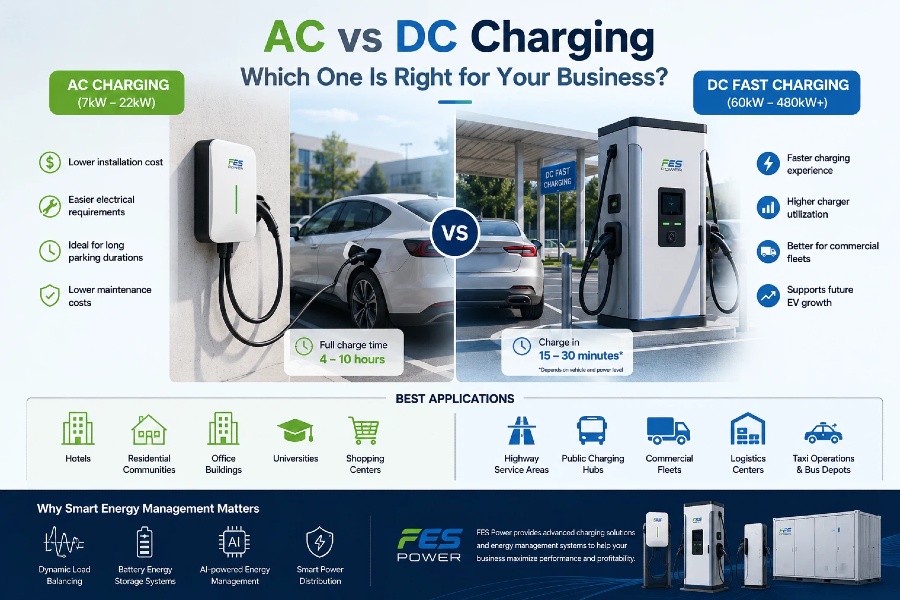
What Is AC Charging?
AC chargers are commonly found in homes, offices, hotels, apartment buildings, and workplace parking areas.
Typical power ratings include:
7kW
11kW
22kW
Most EVs can be fully charged within 4 to 10 hours, depending on battery size and vehicle specifications.
Advantages of AC Charging
✅ Lower installation cost
AC chargers are significantly more affordable than DC fast chargers, making them suitable for businesses with limited budgets.
✅ Easier electrical requirements
Most AC chargers can be installed without major upgrades to existing electrical infrastructure.
✅ Ideal for long parking durations
If vehicles remain parked for several hours, such as at hotels, office buildings, or residential communities, charging speed is often less critical.
✅ Lower maintenance costs
With simpler internal components, AC chargers generally require less maintenance over their lifetime.
Best Applications for AC Charging
Hotels
Residential communities
Office buildings
Employee parking lots
Universities
Shopping centers with extended parking durations
What Is DC Fast Charging?
DC chargers deliver power directly to the vehicle battery, bypassing the onboard charger.
Typical power ratings include:
60kW
120kW
180kW
240kW
480kW+
Liquid-cooled ultra-fast charging systems
Depending on vehicle compatibility, DC charging can add hundreds of kilometers of driving range in as little as 15–30 minutes.
Advantages of DC Charging
✅ Faster charging experience
Speed is the primary advantage. Drivers spend less time waiting and more time on the road.
✅ Higher charger utilization
More vehicles can be served each day, increasing potential revenue for charging station operators.
✅ Better for commercial fleets
Fleet operators often require rapid vehicle turnaround to maximize productivity.
✅ Supports future EV growth
As battery capacities increase and charging expectations rise, fast charging infrastructure becomes increasingly important.
Best Applications for DC Charging
Highway service areas
Public charging hubs
Commercial fleets
Logistics centers
Taxi operations
Bus depots
High-traffic urban charging stations
The choice ultimately depends on how long your customers typically stay parked.
If customers park for several hours, AC charging is often sufficient and more economical.
If customers expect quick charging and fast turnover, DC charging becomes the better investment.
Why Many Businesses Are Choosing Both
A growing number of charging site operators are adopting a hybrid approach.
For example:
AC chargers for employees or overnight users
DC fast chargers for visitors and public charging customers
This strategy maximizes flexibility while improving infrastructure utilization.
By combining both technologies, businesses can serve a wider range of EV users and create multiple revenue streams.
The Role of Smart Energy Management
As charging demand increases, energy management becomes just as important as charging speed.
High-power DC chargers can create significant peak loads, increasing electricity costs and placing pressure on local grid infrastructure.
This is where technologies such as:
Dynamic Load Balancing
Battery Energy Storage Systems (BESS)
AI-powered Energy Management
Smart Power Distribution
can make a significant difference.
By intelligently managing available power, businesses can reduce peak demand charges, improve charger utilization, and optimize overall operating costs.
How FES Power Supports Your Charging Business
At FES Power, we understand that every charging project has unique requirements.
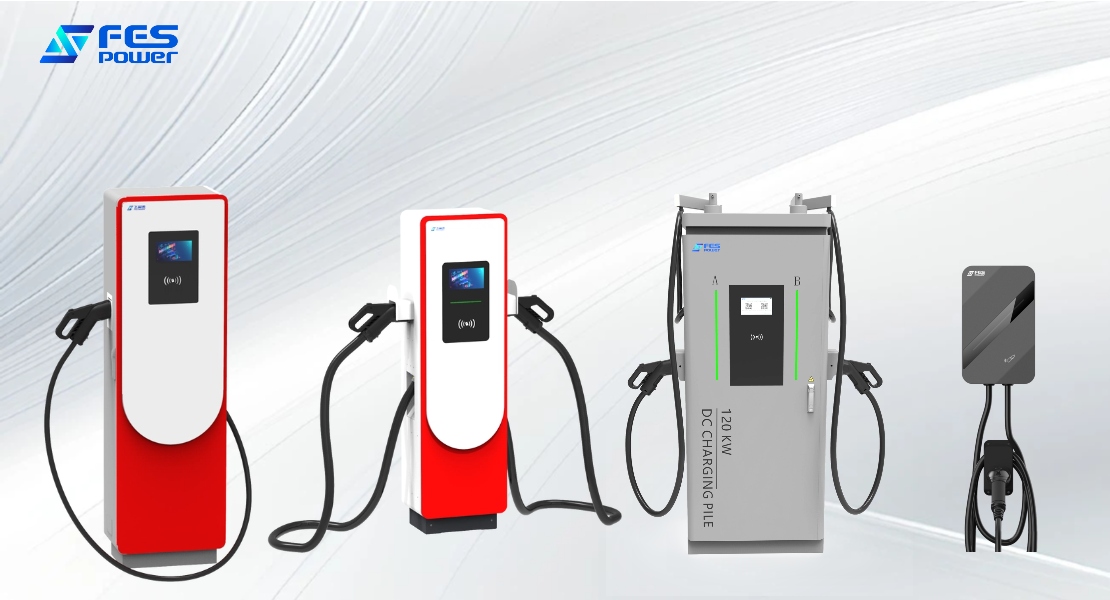
Our portfolio includes:
DC Fast Chargers (60–480kW+)
Liquid-Cooled Ultra-Fast Charging Systems
Battery Energy Storage Solutions
Dynamic Load Balancing Technology
Integrated Smart Charging Platforms
Whether you're building a workplace charging network, a commercial fleet depot, or a high-power public charging hub, our team can help design a solution that balances performance, scalability, and long-term profitability.
There is no universal answer to the AC vs DC charging debate.
AC charging offers affordability and simplicity, making it ideal for locations where vehicles remain parked for extended periods.
DC charging delivers speed and higher revenue potential, making it essential for public charging networks and commercial operations.
For many businesses, the most effective strategy is a combination of both, supported by intelligent energy management and future-ready infrastructure.
As EV adoption continues to accelerate, selecting the right charging solution today can position your business for long-term success tomorrow.



 IPv6 network supported