Nov 24, 2025
The global EV market is entering a high-speed growth phase. In 2025 alone, worldwide EV sales are projected to exceed 20 million units, up from 14 million in 2023. This rapid adoption is driving governments and companies to accelerate fast-charging deployment. China currently leads the world with 18.64 million charging points, including 4.53 million public chargers, while the U.S. and Europe are expanding 150–350 kW chargers at record speed. The common ambition is clear: reduce charging waiting time and support mass electrification.
🔌How Are Major Countries Upgrading Their Fast-Charging Networks? 🚀
China recently announced a 2025–2027 national action plan to double its public charging capacity, aiming for 28 million charging facilities and over 300 GW of public charging load by 2027. In the U.S., companies like ChargePoint are rolling out fast chargers designed for 10-minute charging sessions, while Hyundai is pushing for 400 kW+ ultra-fast charging, targeting near “fuel-station speed.” Europe is also investing heavily in highway fast-charging corridors to meet its Fit-for-55 climate mandate. Together, these initiatives reveal a global race to build dense, high-power networks.
⏱️Why Is High-Power Charging Becoming Non-Negotiable? ⚡
Consumers expect EVs to charge as fast as they refuel. Today’s standard EV charging still requires 30–40 minutes at a 100–150 kW charger, but new systems aim to reduce this to 5–10 minutes. To enable these speeds, stations must support higher power, better cooling, and upgraded distribution systems. Studies show that regions with reliable fast charging see 30% higher EV adoption rates, proving that charging convenience directly shapes market growth.
📡What Role Does Smart Charging and Software Intelligence Play? 🤖
Charging infrastructure is no longer just hardware—it’s a cloud-connected ecosystem. Platforms now offer real-time charger availability, dynamic load balancing, and predictive energy management. Google Maps’ new charger-availability forecasting feature is a major milestone, helping reduce user wait times and optimizing station traffic flow. These intelligent systems help operators avoid peak load stress while improving overall user experience.
⚡How Do Emerging Technologies Like Wireless Charging and V2G Accelerate Progress? 🔄
Wireless charging pilots in the U.S. and Europe aim to power vehicles while parked or even in motion, while China is rapidly scaling V2G (Vehicle-to-Grid) deployment, targeting 5,000+ bidirectional stations by 2027. V2G allows EVs to export power back to the grid—creating virtual power plants and supporting grid stability. These technologies represent the next wave of EV-energy integration, enabling smarter, more flexible energy ecosystems.
🌐How Does FES Power Contribute to the Global Fast-Charging Revolution? 🔋
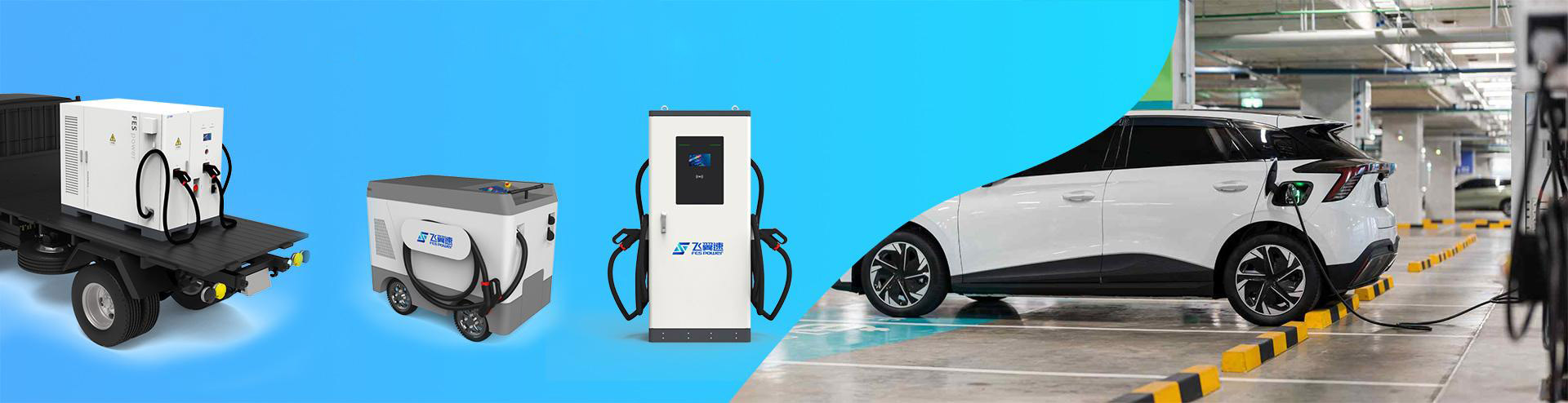
At FES Power, we are committed to empowering the next generation of high-performance charging. Our flagship solutions include:
⚡ FES DC Fast-Charging Series (30–240 kW)
🔷Optimized for highway and commercial applications
🔷Supports ultra-fast charging requirements and scalable power modules
🔷Built with high-efficiency SiC power components
🔷Ideal for fleet charging, public stations, and industrial deployment
⚡ FES Wallbox Series (7–22 kW)
🔷Smart home charging with app monitoring
🔷RFID, Bluetooth, and OCPP communication
🔷Compact, durable, and easy to install
⚡ FES Mobile Charging Vehicle
🔷Emergency rapid charging for stranded EVs
🔷Ideal for remote areas, logistics fleets, and roadside assistance
With global charging demand projected to triple by 2030, FES Power is actively supporting operators, governments, and partners in building reliable, high-speed and intelligent charging ecosystems.
🔮What Does the Future of Fast-Charging Look Like? 🚗⚡
By 2030, experts predict more than 50% of public chargers will be high-power systems above 150 kW, while ultra-fast 350–500 kW stations become common along highways. Integrated energy storage, AI-powered management, wireless charging lanes, and bidirectional energy trading will redefine how vehicles interact with energy networks. The nations that build fast, dense, and intelligent charging ecosystems will lead the next decade of global electrification.
Read More






 IPv6 network supported