Customized Electric Vehicle Charger Enterprise
Home

High Power EV Chargers

High Power EV Chargers

  • Which EV Charging Trends Truly Mattered in 2025 — and Which Ones Didn’t?
    Which EV Charging Trends Truly Mattered in 2025 — and Which Ones Didn’t?
    Dec 29, 2025
    🚗As 2025 comes to a close, the EV charging industry has clearly moved beyond early-stage experimentation and into a phase of real-world validation. But amid rapid expansion, not every trend delivered the value it promised. So, which EV charging trends truly shaped the industry this year—and which ones quietly lost momentum? Let’s take a closer look.  ✅1. Did Reliability Finally Overtake Power as the Top Priority? 🔌 Was 2025 the year when uptime became more important than headline power figures? 🧩⚡Across multiple markets, operators began prioritizing stable performance, fault tolerance, and long-term reliability over simply installing higher-kilowatt chargers. Downtime proved far more costly than slower charging speeds, pushing stakeholders to rethink what “high performance” really means. ⚙️📉 🔋2. Did Modular Charging Architecture Become the New Industry Standard?  Why did modular and split-type charging systems gain so much traction in 2025? 🔄The answer lies in scalability and maintenance efficiency. Modular designs allowed operators to expand capacity incrementally, reduce single-point failures, and simplify servicing—all while improving overall station availability. For large-scale or high-traffic charging sites, this approach increasingly became the default choice.  🌍3. Was Grid Compatibility the Real Bottleneck Revealed in 2025?  Did grid constraints emerge as the hidden challenge behind many EV charging projects? ⚡As deployment accelerated, grid integration—rather than charger hardware—often dictated project timelines. Smart load management, power balancing, and grid-friendly designs proved essential in avoiding costly upgrades and regulatory delays. This shift highlighted that charging infrastructure must work with the grid, not against it.  🔧4. Did O&M Costs Finally Enter the Decision-Making Spotlight?  Were operators forced to reconsider total cost of ownership in 2025? Absolutely. Rising energy prices and labor costs pushed operations and maintenance (O&M) into boardroom discussions. Chargers that offered remote monitoring, predictive maintenance, and simplified servicing gained a clear competitive edge, as long-term operational efficiency became just as important as initial CAPEX. 📊🛠️ 🚀5. Did High-Power Charging Find Its Right Use Cases?  Did the industry finally learn where ultra-high-power charging truly makes sense? 📍Rather than deploying high-power chargers everywhere, 2025 saw a more strategic approach. Logistics hubs, highways, and fleet depots emerged as ideal scenarios, while other locations benefited more from balanced power distribution. The focus shifted from “more power” to “right power, right place.”  So, Which Trends Didn’t Live Up to Expectations?  ⚠️Did Chasing Extreme Power Levels Deliver Real ROI?  Despite the hype, blindly pursuing ultra-high power without considering utilization rates often resulted in underused assets and higher costs. In many cases, the return simply didn’t justify the investment.  ❓Did Overly Complex Smart Features Add Real Value?  While digitalization remains important, some overly complex features failed to improve user experience or operational efficiency. Simplicity and reliability consistently outperformed unnecessary sophistication in real-world deployments.  🎯What Did 2025 Ultimately Teach Us About EV Charging?  Was 2025 the year the EV charging industry became more pragmatic? ⚡The evidence suggests yes. Decisions were increasingly driven by real-world performance, scalability, and long-term value, rather than marketing claims. As the industry moves into 2026, these lessons will likely shape a more sustainable and resilient charging infrastructure landscape. 🌱
    Read More
  • How CaaS Is Reshaping the Economics of EV Charging Stations
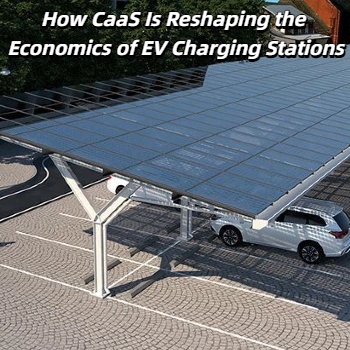
    How CaaS Is Reshaping the Economics of EV Charging Stations
    Apr 10, 2026
    The EV charging industry is entering a new phase where business models matter just as much as hardware. 🚗⚡ Traditionally, deploying EV charging stations required significant upfront capital investment, long payback periods, and operational complexity. But today, Charging-as-a-Service (CaaS) is fundamentally reshaping the economics behind how charging networks are built, scaled, and monetized. 💡 Why Traditional Charging Economics Are ChallengingFor years, the biggest barrier to EV charging expansion has been financial rather than technical. Building a charging station often involves high CAPEX, grid upgrade costs, and uncertain utilization rates. ⚠️ Operators face multiple layers of risk: 🔌 Heavy upfront investment in equipment and infrastructure 📉 Unpredictable revenue due to fluctuating EV adoption ⚡ High electricity demand charges impacting profitabilityThese challenges make it difficult for many businesses—especially new entrants—to justify large-scale deployment. As a result, growth has often been slower than market demand. 🔄 What Is CaaS and Why Does It Change Everything?Charging-as-a-Service (CaaS) introduces a fundamentally different approach. Instead of owning and operating charging infrastructure, businesses can access it through a service-based model.  This shift transforms the financial structure: 💸 CAPEX is replaced with OPEX, reducing initial investment pressure 🚀 Deployment becomes faster, as infrastructure is managed by providers 🧠 Operational complexity is outsourced, allowing operators to focus on users and growth In essence, CaaS lowers the barrier to entry while enabling faster scaling—two critical factors in a rapidly growing EV market. 📊 How CaaS Improves ROI for Charging StationsOne of the most important impacts of CaaS is its ability to improve return on investment. 📈By optimizing both cost structure and operational efficiency, CaaS enhances profitability in several ways: ⚙️ Better asset utilization through smart energy and load management 🔋 Integration with energy storage systems to reduce peak electricity costs 📡 Data-driven optimization that improves uptime and user experienceRather than relying solely on charging fees, operators can build more stable and predictable revenue streams. This is especially important as competition increases and margins tighten. ⚡ The Role of Smart Energy and High-Power Charging CaaS is not just a financial model—it is deeply connected to technology evolution. 🔍Modern CaaS solutions increasingly integrate: 🌞 Renewable energy sources like solar 🔋 Energy storage systems to balance load and reduce grid dependency ⚡ High-power DC fast charging to improve throughput and user satisfaction This combination turns charging stations into intelligent energy hubs rather than simple power delivery points. The result is a more resilient and scalable infrastructure that can adapt to future demand, including ultra-fast and even megawatt-level charging. 🌍 Why CaaS Is Accelerating Global EV AdoptionAs governments and industries push toward electrification, scalability becomes critical. 🌱 CaaS plays a key role in accelerating deployment across different regions and use cases. It enables: 🏙️ Rapid rollout in urban environments where space and grid capacity are constrained 🚚 Expansion into commercial fleets that require predictable charging costs 🌐 Easier entry into emerging markets with limited infrastructure investment capacityBy removing financial and operational barriers, CaaS helps align infrastructure growth with the accelerating pace of EV adoption. 🎯 Conclusion: From Hardware Sales to Energy ServicesThe rise of CaaS marks a clear shift in the EV charging industry—from selling equipment to delivering integrated energy solutions. 🔄 In this new landscape: ⚡ Value is created through efficiency, flexibility, and service quality 📊 Data and energy management become as important as hardware performance 🚀 Scalable, service-driven models define long-term competitiveness For businesses looking to enter or expand in the EV charging space, embracing CaaS is no longer optional—it is becoming essential.
    Read More

leave a message

leave a message
If you are interested in our products and want to know more details,please leave a message here,we will reply you as soon as we can.
submit
Contact Us: bella@fespower.cn

home

products

WhatsApp

Contact Us