Jan 14, 2026
As electric vehicles continue to gain momentum worldwide, ultra-fast charging has become a critical part of modern EV infrastructure. But the term “ultra-fast charger” can refer to very different technologies and system designs.
So, what types of ultra-fast EV chargers are actually available on the market today? This article provides a clear, practical overview from a technical and application-focused perspective.
🔋What Is Considered an Ultra-Fast EV Charger?
In general, the industry defines ultra-fast charging as DC charging systems with power levels of 150 kW and above. In high-demand scenarios such as highways, charging hubs, and fleet depots, total system power can reach 300 kW, 480 kW, or even 960 kW and beyond.
The goal of ultra-fast charging is not only shorter charging time, but also:
✨Higher station throughput
✨Better power utilization
✨Scalability for future EV models
⚙️What Is an Integrated DC Fast Charger?
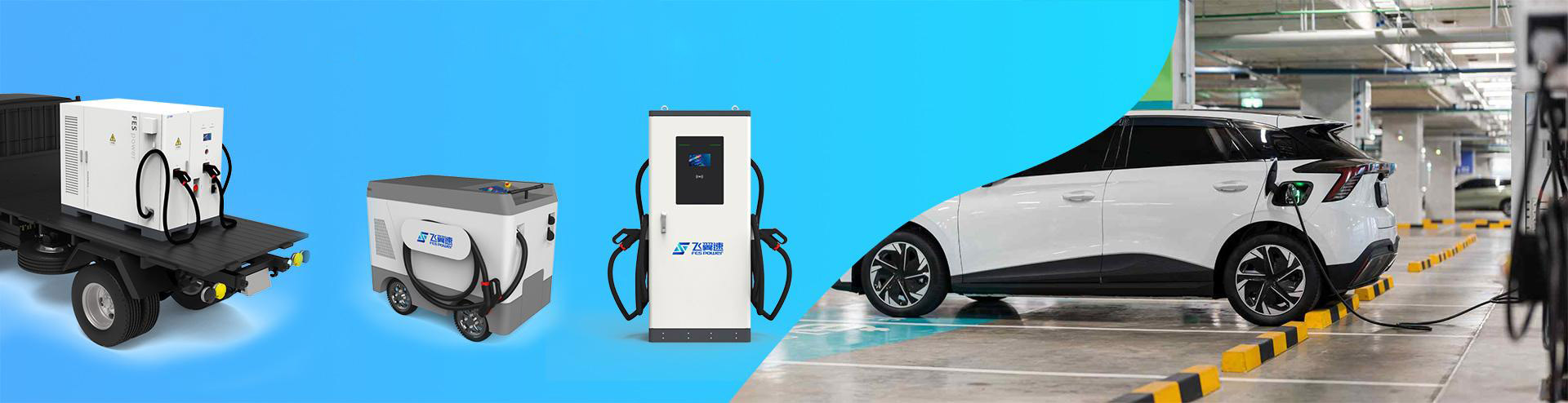
Integrated DC fast chargers combine the power modules, control system, and charging connectors into a single cabinet.
Key characteristics:
💫Typical power range: 60–240 kW
💫Compact, all-in-one design
💫Easier and faster to deploy
Common applications:
🟠Commercial parking lots
🟠Small public charging sites
🟠Early-stage EV infrastructure projects
While integrated chargers are convenient, their fixed power configuration limits flexibility when multiple vehicles need to charge simultaneously.
🔌What Is a Split-Type DC Charging System?
A split-type (or separated) DC charging system divides the charging infrastructure into:
🔸A central power cabinet
🔸Multiple charging dispensers
Advantages include:
🔸Total system power up to 360–960 kW
🔸Power shared among multiple charging points
🔸Easier expansion without replacing the entire system
This architecture has become the mainstream solution for ultra-fast charging stations, especially where high utilization is required.
🔄What Is a Flexible or Dynamic Charging System?
Flexible charging is not a standalone hardware category, but a system-level capability.
It allows power to be:
🔅Dynamically allocated based on vehicle demand
🔅Adjusted in real time during charging
🔅Shared efficiently across multiple vehicles
For example, instead of assigning fixed power per connector, a flexible system can distribute power such as 200 kW + 120 kW + 80 kW simultaneously—maximizing the use of available capacity.
This approach is essential for busy charging hubs and fleet operations.
🏗️What Is a Centralized Ultra-Fast Charging System?
A centralized ultra-fast charging system focuses on delivering very high total power from a shared power source.
Typical features include:
🔅Centralized power cabinets (e.g. 480–960 kW)
🔅Modular power units
🔅Support for 2–16 simultaneous charging points
Ideal use cases:
🔻Highway service areas
🔻Urban fast-charging hubs
🔻Logistics fleets and bus depots
Centralized systems reduce infrastructure redundancy and improve long-term operational efficiency.
❄️Why Are Liquid-Cooled Chargers Important for Ultra-Fast Charging?
As single-connector power levels exceed 250 kW, traditional air-cooled charging cables become heavy and difficult to handle.
Liquid-cooled charging technology enables:
🟡Higher current output (500A–600A)
🟡Thinner, lighter cables
🟡More stable high-power performance
This makes liquid-cooled dispensers a key component of modern ultra-fast charging solutions.
🧠How Should Operators Choose the Right Ultra-Fast Charging Solution?
When selecting an ultra-fast charging system, operators should consider:
🔴Number of vehicles charging simultaneously
🔴Required charging time per vehicle
🔴Grid connection capacity
🔴Future expansion plans
For long-term operation, split-type, flexible, and centralized architectures offer the best balance between performance and scalability.
🌍How Do Modern Solutions Address These Needs?
Advanced solutions, such as FES Power’s high-power DC charging systems, combine:
🟣480–960 kW centralized power cabinets
🟣Wide voltage range (150–1000 V)
🟣Dynamic power distribution
🟣Support for liquid-cooled dispensers
These systems are designed to meet the real-world demands of ultra-fast charging today while remaining ready for tomorrow’s EV technologies.
✅Conclusion: What Do Ultra-Fast Chargers Really Have in Common?
Although ultra-fast chargers come in different forms, the most effective solutions share the same core principles:
🔵High total power
Intelligent power management
Flexible system design
🔋Understanding these differences helps operators, investors, and planners build charging infrastructure that is not only fast—but also efficient and future-proof.
Read More






 IPv6 network supported