Dec 03, 2025
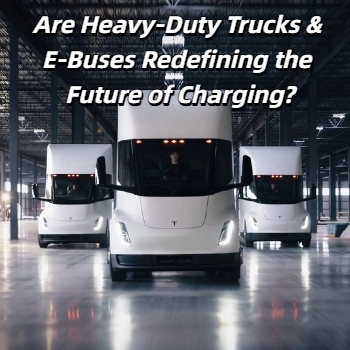
🚛🔌🚌As global transportation pushes toward deep decarbonization, heavy-duty trucks and commercial e-buses are becoming the next strategic battlefield for high-power EV charging. Their massive battery systems, long daily mileage, and tightly scheduled operations are reshaping how charging networks must be designed and deployed.
🚚 Why Are Heavy-Duty Vehicles Becoming the New Catalyst for Electrification?
The electrification of commercial fleets is accelerating rapidly. According to the IEA Global EV Outlook 2025:
Electric heavy-duty truck sales grew 45% year-over-year in 2024
The global e-bus fleet exceeded 1 million units
By 2030, heavy commercial vehicles will account for over 40% of total new charging demand
Compared with passenger EVs, commercial HDVs run longer distances, consume far more energy, and rely heavily on predictable charging schedules, making charging infrastructure a decisive success factor.
⚡ Why Do Heavy Vehicles Require Far Higher Charging Power?
Heavy-duty commercial vehicles typically carry batteries 5–10× larger than passenger EVs. For example:
🔷E-buses often carry 350–500 kWh battery packs
🔷Electric trucks frequently reach 600–1,200 kWh
👉 As a result, charging power must scale accordingly. Global deployments now include:
🔷350–600 kW fast DC chargers for depots and logistics hubs
🔷Europe’s MCS (Megawatt Charging System) pilot sites delivering 1.2–3 MW charging
Fast, high-power replenishment is essential to keep buses and trucks running on schedule, making “high-power DC + intelligent load management” the new industry norm.
🔋 Why Must Charging for Heavy Vehicles Rely on a Grid-Storage-Charging Hybrid Approach?
Truck depots and bus terminals often charge multiple large-battery vehicles simultaneously, leading to extremely high peak loads.
For example:
A depot with 50 e-buses, each charging at 300 kW, may require up to 15 MW — comparable to the load of a small industrial park.
To maintain grid stability and reduce costs, many operators now adopt:
⚡ Grid upgrades (transformers, distribution enhancements)
🔋 Battery energy storage systems (BESS) for peak shaving
📡 Smart charging algorithms to avoid simultaneous peak charging
This integrated model is rapidly becoming the most feasible and economical solution for large commercial fleets.
🏭 How Can Fleet Operators Reduce TCO Effectively?
Total Cost of Ownership (TCO) is the most critical economic indicator for fleet electrification. With the right charging strategy, operators can reduce energy expenses by 15–30%.
Key strategies include:
Off-peak charging to reduce tariffs 🕒
Distributed storage to minimize demand charges 🔋
AI-based charging scheduling 📊
Higher charging efficiency with reduced vehicle downtime 🚍
For fleet operators, the priorities remain clear: charge faster, charge smarter, charge cheaper.
🚀 Why Are FES Power Solutions Optimized for Heavy-Duty Charging?
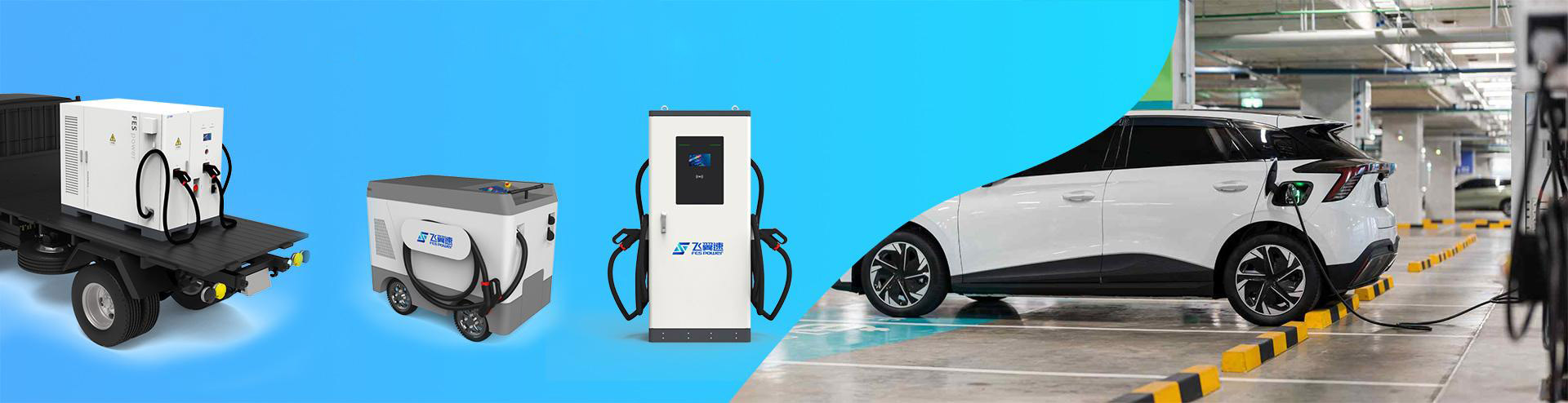
FES Power provides a high-performance charging portfolio specifically designed for bus depots, logistics hubs, and highway corridors.
Our advantages include:
🔹 High-power DC solutions from 30–780 kW
Covering ultra-fast charging needs for commercial fleets.
🔹 Modular architecture for flexible scalability
Scale power modules based on fleet growth and investment plans.
🔹 Dual/Triple-connector systems with intelligent power distribution
Supporting multiple vehicles charging in parallel to maximize station efficiency.
🔹 Full OCPP support + remote monitoring platform
Improving operational efficiency and minimizing maintenance costs.
🔹 Compatibility with CCS2 / GB/T / and MCS-ready designs
Meeting requirements across global markets.
✨ Special Highlight: FES Power Mobile Charging Truck — with Customizable Battery Capacity
In addition to fixed high-power chargers, FES Power also offers a Mobile Charging Truck designed for flexible deployment at depots, temporary sites, rescue charging, or events.
💡 Key advantage:
👉 Battery capacity is fully customizable based on client needs — from standard pack configurations to high-capacity energy modules for long-range or high-power applications.
This provides fleet operators with a dynamic, on-demand charging resource, especially valuable for large depots, remote sites, or operations undergoing transition to full electrification.
🧩 What Challenges Still Slow Down Heavy-Duty Electrification?
Despite rapid progress, the industry faces several obstacles:
🛠 High cost and long timelines for grid expansion
🔌 Megawatt-level charging still in early commercial deployment
📍 Uneven coverage of highway charging corridors
💸 High upfront investment for large fleet depots
📡 Lack of digital management capabilities among some operators
The shift from small demonstrations to full-scale deployment will require coordinated upgrades in infrastructure, standards, and operational models.
🌐 Where Is the Industry Heading in the Next 5 Years?
Experts agree that 2025–2030 will be the breakout period for commercial vehicle charging ecosystems.
Key trends include:
MCS megawatt charging moving from pilots to commercial rollouts ⚡
“Charging + Storage” becoming standard at depots 🔋
V2G applications entering fleet operations 🔄
Digitalized fleet energy management becoming a core competitive advantage 📊
Heavy-duty electrification is not only an energy transition—it is also a catalyst for smarter, more efficient mobility systems.
Read More






 IPv6 network supported